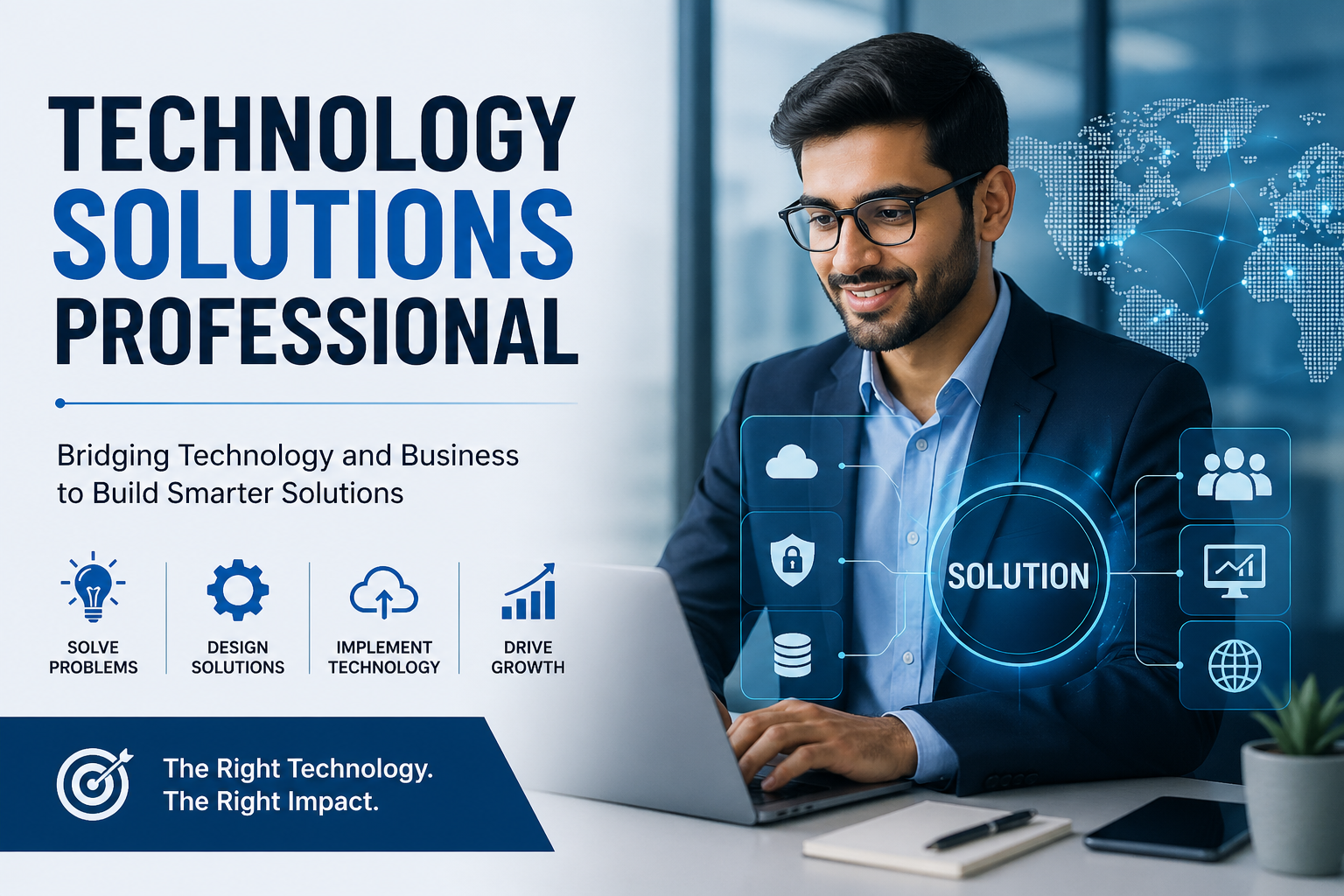
The Technology Solutions Professional is a specialist who can connect business requirements with the appropriate technology to develop practical, efficient, and flexible solutions. Instead of focusing on one specific area of expertise, this job requires a mix of systems, software, cloud platforms, and business processes to tackle real-world challenges. Simply put, they assist businesses in making use of technology in the most efficient manner to increase efficiency, cut expenses, and boost growth.
In the modern world of digital technology, nearly every business depends on technology in some way, whether it’s managing data, assisting customers online, or automating internal operations. The Technology Solutions Professional plays a crucial role in ensuring that the systems are working efficiently. They assess the challenges, create solutions, and frequently oversee the process of implementation from beginning to end.
What Is a Technology Solutions Professional?
A Technology Solutions Professional is someone who works in the middle of technology and business challenges. Instead of focusing on system maintenance or coding, it is focused on determining what a company really needs and then determining the appropriate technological approach to address the problem. Imagine a person who has the idea, “We need to improve customer experience,” and then transforms that vague idea into a practical system with cloud-based tools such as data analytics, data mining, or even automation. This is the core of the career.
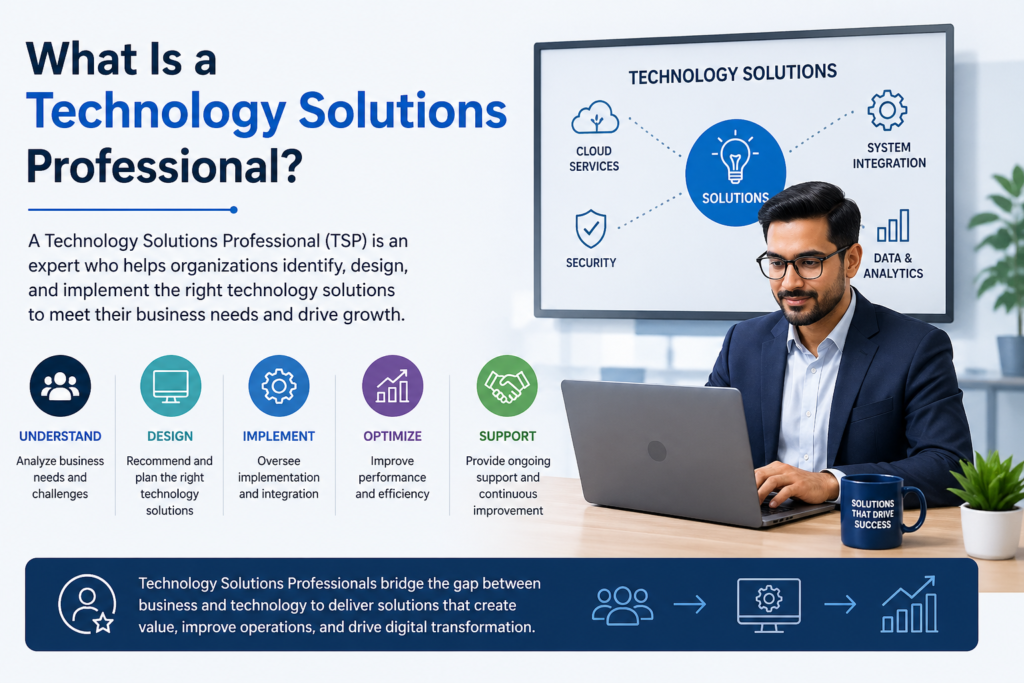
The job is constantly changing and constantly changes to keep up with the latest technological developments. For instance, one day you may be working on moving your company’s infrastructure into the cloud, while the next day you might help integrate the use of artificial intelligence in customer service systems. It’s not a repetitive task; it’s an innovative approach to solving problems on an enormous scale. It’s not just about fixing problems, but you’re creating better systems to prevent these problems from occurring at all in the first place.
A further aspect that is essential to the work of a tech professional is communication. Technology solutions professionals often act as an intermediary between the technical team and business managers. You may be able to explain a complicated structure in a simple way to senior executives or convert the business needs into simple instructions for developers. The ability to connect two different worlds is what makes the job so important.
In the end, being a tech solutions specialist is all about the impact. Your job is to help organizations function more quickly, effectively, and more efficiently. In a time where technology is the driving force behind almost every decision, this job is now more important than ever.
Importance in Modern Businesses
Modern businesses rely extensively on technological advancements, but tools on their own aren’t enough. Without the proper strategy, even the most sophisticated technology is susceptible to failure. This is where experts in technology solutions are in the picture, ensuring that technology investments are actually delivering value.
Imagine how fast companies are transforming to digital. From cloud-based platforms for e-commerce to cloud-based operations, companies are always improving their technology. According to research from industry experts, which shows that over 70% of companies are investing heavily in digital transformation, and they require experts to assist them in navigating these changes. Without proper planning, businesses are at risk of spending money on devices that aren’t in line with their objectives.
Another reason that this role is vital is its effectiveness. An efficient solution will save time, lower expenses, and boost productivity. For instance, automating repetitive tasks could free employees to do more strategic tasks. This isn’t just a technological enhancement, but also a benefit for business.
Customer experience is an additional important aspect. Nowadays, customers expect quick, smooth, seamless, and customized interactions. Professionals in technology solutions design systems that enable this with everything, including recommendation engines, to mobile apps that are responsive.
In a nutshell, they are the motor of digital success. Businesses that make use of their expertise are more likely to develop faster and keep ahead of their competitors.
Core Skills Required
Technical Skills
To be successful as a Technology Solutions Professional, technical abilities are the foundation of your career. However, it’s not about being able to master everything, but rather understanding the ways that different technologies interact and collaborate to develop solutions.
The most crucial areas of cloud computing are cloud computing. Platforms such as AWS, Azure, and Google Cloud dominate the industry. They allow companies to expand their operations and store data in a streamlined manner, and also deploy apps globally. Understanding how to create cloud-based structures is an immense benefit.
Another crucial ability can be found in data analytics. Companies generate huge amounts of data. However, without the right analysis, it’s ineffective. Tools such as SQL, Power BI, and Tableau assist in transforming the raw data into valuable insights that guide decisions.
The ability to program is also important. You don’t have to be a professional developer, but having a solid understanding of languages such as Python or JavaScript allows you to collaborate with teams in technical areas and create custom solutions when required.
Security of cyberspace is equally important. With an increase in cyberattacks, businesses require secure systems. Knowing about encryption, security of networks, and compliance standards ensures that the solutions are not only efficient but also secure.
Soft Skills
While technical skills are important, soft skills make you stand out. Communication is the most important on the list. It is common to explain complicated concepts to non-technical individuals, and therefore clarity is essential.
The ability to solve problems is a must-have. Every project has its own challenges, and your ability to think critically and come up with solutions will determine your success. It’s like solving puzzles in which the pieces change.
It is important to be flexible. Technology changes rapidly, and staying current means always learning new methods and tools.
The importance of teamwork is equally significant. You’ll be working with managers, developers, and customers, so the ability to collaborate with other people is essential.
Tools and Technologies
Essential Tools
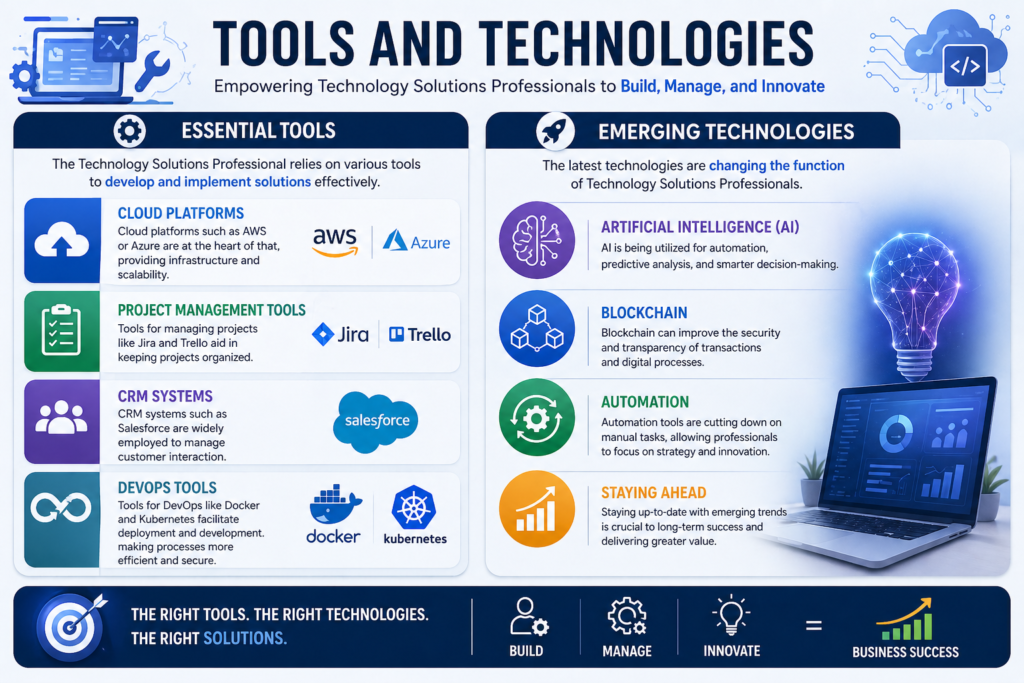
The Technology Solutions Professional relies on various tools to develop and implement solutions. Cloud platforms such as AWS or Azure are at the heart of that, providing infrastructure and scalability.
Tools for managing projects like Jira and Trello aid in keeping projects organized. CRM systems such as Salesforce are widely employed to manage customer interaction.
Tools for DevOps like Docker and Kubernetes facilitate deployment and development, which makes processes more efficient and more secure.
Emerging Technologies
The latest technologies are changing the function. Artificial Intelligence (AI) is being utilized for automation as well as predictive analysis. Blockchain can improve the security and transparency of transactions.
Automation tools are cutting down on the need for manual labor, which allows professionals to concentrate on the strategy. Staying up-to-date with the latest trends is crucial to long-term success.
Education and Certifications
Degree Paths
The majority of Technology Solutions Professionals have qualifications in computing science and IT as well as software engineering. These degrees provide a solid foundation in programming and system design.
But alternative routes like online classes and bootcamps are becoming more popular. Experience is often more than formal training.
Certifications
Certifications increase credibility. Some of the most popular options include:
- AWS Solutions Architect
- Microsoft Azure Certifications
- CISSP for cybersecurity
Certifications that are specific to vendors, such as NetApp, can be beneficial in specific tasks.
Career Opportunities
Job Roles
This field is a variety of tasks, including:
- Solutions Architect
- IT Consultant
- Cloud Engineer
- Technical Account Manager
Each job is focused on solving business issues using technology.
Salary Trends
Salaries can be competitive. Starting salaries for entry-level positions start at around $60,000, while professionals are able to earn upwards of $120,000. Particularized jobs often go beyond this amount.
Daily Responsibilities
Typical Workday
The typical day includes meetings, designing systems, and troubleshooting. It is possible to analyze needs in the morning and implement them during the evening.
Team Collaboration
Collaboration is a constant. You collaborate with stakeholders, developers, and customers to ensure that the solutions you choose to implement meet your expectations.
Challenges in the Field

Technical Challenges
Controlling legacy systems and maintaining scalability are major challenges. Security is an ever-present issue.
Business Challenges
The changing requirements and budget limitations can make projects more difficult. The balance between business and technical requirements is crucial.
Future Outlook
Industry Trends
AI cloud computing and automation will continue to influence the field. The demand for skilled professionals is increasing.
Growth Opportunities
Growth in your career is steady, and there are opportunities to advance to leadership positions such as CTO and Solutions Architect.
Conclusion
A Technology Solutions Professional plays a vital role in modern companies by integrating technical knowledge and business strategies. It’s a profession that is full of possibilities, challenges, and constant learning.
Latest Article: MyOLSD Portal Login Explained for Students and Parents
FAQs
1. What is a Technology Solutions Professional?
A professional who develops and implements technological solutions to tackle business challenges.
2. What are the skills required?
cloud computing and problem solving, communication, data analysis, and cybersecurity fundamentals.
3. What is the median salary?
It typically ranges from $60,000 up to $130,000+ annually, depending on the experience.
4. What kinds of jobs are there for you to get?
The roles include solutions designer, consultant in information technology, cloud engineer, and technical expert.
5. Do I require a degree?
It’s not always the case, but having a diploma with a focus on IT and computer science is typically preferable.
6. Do you think certification is important?
Yes, certificates like AWS, Azure, or NetApp increase the chances of getting a job.
7. What exactly is NetApp certification?
A credential that focuses on cloud and data storage infrastructure technologies.