Wechat Event Ticketing Mini Program grown from basic booking tools into advanced ecosystem platforms that integrate ticketing, social interaction, marketing automation, and data analytics. With WeChat’s 1.3billion monthly active users, these applications provide businesses with unparalleled access to the Chinese market via scanning QR codes with search functions, as well as social sharing. This guide synthesizes the knowledge of leading sources to present the complete framework for developing the foundation, launching, and enhancing the event ticketing mini-programme that is superior to current solutions.
What is a Wechat Event Ticketing Mini Program?
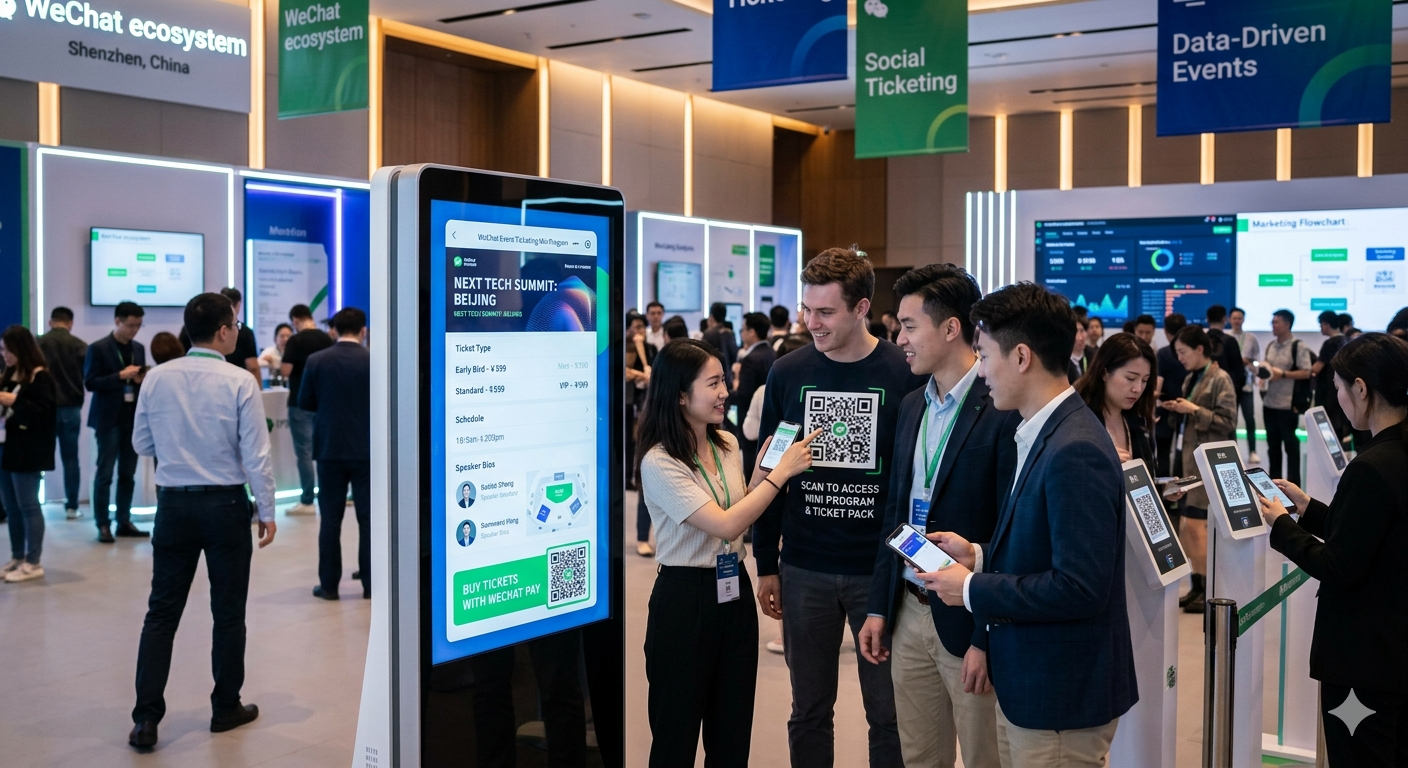
A WeChat Event Ticketing Mini Program is a small, integrated application that is part of the WeChat ecosystem that lets users to find events, book, and buy tickets for events without leaving the WeChat application.
Contrary to the traditional mobile applications, which require downloading from an App Store, miniature applications can be described as “sub-applications” that run instantly. In the case of event ticketing, this means that the organizer is able to create an interactive and brand-named interface for attendees that lets them:
- Check out event information as well as schedules and speaker bios.
- Select types of tickets (e.g., Early Bird General Admission, VIP, Early Bird).
- Securely pay with WeChat Pay.
- You can receive a digital ticket (QR codes) saved in the mini-program or included in the WeChat “Card Pack.”
- Check-in is done by scanning a QR code at the location.
The ecosystem is a seamless one. Because WeChat is home to more than 1.2 billion active monthly users and the WeChat mini-programme for event tickets serves as an intermediary to social media advertising and conversion of transactions. It removes the friction. Users can see an event’s poster in the Moments feed or Group Chat and click on the link, and instantly are in an interface for ticket purchases.
For businesses looking to understand the full potential of Mini Programs beyond ticketing, Tencent’s official WeChat Mini Program documentation provides a comprehensive overview of features, development tools, and case studies. This resource is invaluable for developers and marketers seeking to create high-performing applications within the WeChat ecosystem.
Why Use a Wechat Event Ticketing Mini Program?
To appreciate the significance of this device it is necessary to understand the habits of the contemporary consumer, specifically in Asia. People are used to an experience that is closed loop. They don’t want to be directed to a website or enter long form information or download an additional application.

1. Unmatched Reach and Social Integration
WeChat is one of the social networking site first. The value of a ticketing-related mini-programme is in its potential for virality. If a user purchases tickets, they are able to give the event’s card straight to their Moments or specific groups. It is a “Friend-to-Friend” trust factor is far more effective than traditional digital marketing. A WeChat mini-programme for event ticketing makes use of Social graphs to produce natural, authentic promotion.
2. Reduced Friction (The “No-Exit” Strategy)
Each time a user needs to quit an app to make a purchase, the conversion rate decreases by around 20% to 30 20%. With a mini program the transaction is completed instantly through WeChat Pay that is already connected to the user’s account at a bank. It is not necessary to input credit card details. The “one-click” purchase capability dramatically enhances the chance of impulse purchases as well as last-minute registrations.
3. Data Ownership and CRM
When your users interact with your mini-programme You gain access to vital information (with their permission). It is possible to track who visited your event and who walked away from the cart, and even who bought. Because mini-programmes are hosted by the official WeChat account You can target these users using official templates for your account or follow-up messages about the event.
4. Security and Anti-Counterfeiting
In the ticketing business there is a huge fraud problem. Paper tickets are a common way to be duplicated. But QR codes created by the WeChat mini-programme for event tickets are dynamic and secure. They are refreshed every few seconds, or specific to the user’s specific WeChat ID. This means it is only the initial buyer (or the designated recipient) is able to gain access to the event, preventing scalping and counterfeit tickets.
Key Components of a Wechat Event Ticketing Mini Program
In order to build or select the best solution, you must be aware of the structure. A reliable WeChat event ticketing mini-program generally consists of a number of core modules:

The Event Discovery Page
This is the homepage. It serves as a shopfront for the upcoming events. Videos, images of high quality, and countdown timers are crucial for this. The layout must be clear, sorting events by type (Music Business, Sports, Music) or by date.
The Ticketing Engine
This is the logic behind that takes care of:
- Controlling Inventory: Creating limits for different ticket levels.
- Time-based Releases automatically change between “Early Bird” and “Standard” prices on certain days and hours.
- Seat Mapping for places with seating assigned visual seat maps allows patrons to choose particular row and seating. This is a complicated feature that is crucial for high-end show or concert performances.
The Check-in System
One of the most important aspects that is often ignored is the on-site administration. The mini program typically comes with the “Organizer” mode or an interface or app that is a companion to the. Staff members at the venue use smartphones or scanners to scan the QR codes. The system validates the ticket at any time as well as flags duplicates and marks the ticket as “used.”
The Social Sharing SDK
The application should have native buttons that permit users to post the invitation card, the promotional poster, or even their “attending” status directly to WeChat Moments and Chat Groups. The simpler it is to share, the greater the reach of your organic reach.
How to Create a Wechat Event Ticketing Mini Program
Making a mini-programme isn’t as easy as downloading an app. it requires a strategy. There are generally two paths: using a Software-as-a-Service (SaaS) provider or custom development.

Step 1: Secure Your WeChat Ecosystem Assets
Before you write the code line or sign up for a service, you need the fundamental WeChat assets:
- WeChat Official Account: Specifically, a Service Account. Mini-programmes are typically connected to Service Accounts to make it easier to send templates (like sending out a reminder on the day before an occasion) and allow users to locate your program by using the account menu.
- WeChat Pay Merchant Account: You have to apply for a WeChat Pay merchant account to make transactions. This will require a business license as well as the verification of your account with a bank.
Step 2: Choose Your Development Path
Option A: SaaS Ticketing Platforms
For the majority of event planners (from smaller workshops up to huge corporate events), an outside SaaS system is the ideal method. Companies such as Huodongxing (Huo DongXing ), Yoopay, or custom marketing agencies can provide white-label services.
- Pros: Quick setting up (days instead of. months) and built-in check-in applications. Customer support, speedy setup, and compatibility with WeChat’s evolving APIs.
- Cons: Monthly charges or commissions per ticket. Limited customisation on UI design.
Option B: Custom Development
If you’re a huge corporation, stadium or a festival that has particular requirements (complex seating, distinctive loyalty integrations) then you should employ a WeChat-authorized developer.
- Pros: Complete control over user experience, data and branding.
- Cons: Expensive upfront cost (anywhere between $10,000 and $50,000plus) and a longer time to develop You are also responsible for ensuring compliance with WeChat’s changes.
Step 3: Design for Mobile-First Experience
Utilizing a template or a custom script, design should be mobile-friendly. The majority of users browse in the subway or during lunch breaks.
- Time to Load: Your program should be launched in less than two seconds.
- Visual Hierarchy It is important that the “Buy Ticket” button is affixed (always visible on the screen).
- Simple Formulas Utilize WeChat’s “Get Phone Number” feature to fill in user information automatically. Don’t request irrelevant fields such as full address, unless you are shipping physical tickets.
Step3 4: Integrate WeChat Pay
Check that the flow of payment is optimised. WeChat Pay requires a specific redirect URL and a callback configuration. Your program should be able to handle unsuccessful payments quickly (e.g. when users close the browser, the program should send them an error message that allows them to make the payment in the future).
Step 5: Testing and Compliance
Before you launch, you must submit your mini program for review to WeChat to be evaluated by WeChat. WeChat is a strict platform for “Virtual Payments” and “Content.” Make sure your event description doesn’t include banned keywords. Also, ensure make sure your policy on refunds is displayed on the interface of the program to prevent rejection.
Real-World Use Cases
To fully grasp the potential of the WeChat mini program for event ticketing let’s examine the different ways that various industries use the program.
Case Study 1: The International Music Festival
A major EDM Festival in Shanghai sought to sell tickets with tiered categories: Super Early Bird (limited 500), Early Bird (1000) and VIP (with exclusive access). They made use of a custom mini-programme.
- Implementation: The program utilized an hourly countdown for each level. If you reached the Super Early Bird sold out in just 2 min, it became grayed out, while it became active. Early Bird tier became active.
- The result: They sold 40 percent of their tickets in the first hour, due to social sharing. VIP ticket holders were given an additional QR code to use to check-in at the VIP lounge and management was done through the same interface, which reduces the amount of confusion that occurs on site.
Case Study 2: Corporate B2B Conference
A business consulting company held a ticketed ($500 per person) leader summit.
- Implementation: They employed the SaaS mini-programme that was that was linked with their service account. Participants registered through their program. The application had an option to choose the breakout session (lunch or learning tracks). After registering, attendees received the digital badge along with an QR code.
- Results Day-of-the-week the check-in process took just 10 seconds per person. The company used the information to identify the breakout sessions that were the most popular and provided important information for future plan.
Case Study 3: Non-Profit Charity Gala
A charity was looking to sell tickets and take donations without excessive transaction fees eating into the profits.
- Implementation: They implemented an app that allows the use of “pay what you want” ticketing, as well as a distinct “donation” button.
- Its results: The inclusion of WeChat Pay let donors donate immediately after watching emotions-filled promotional videos that were shared on the official account of the charity which raised 30 percent more than last year’s sales of physical tickets.
Challenges and Limitations Of Wechat Event Ticketing Mini Program
Although the WeChat mini-programme for event ticketing is a great tool, it’s not without challenges. Knowing the limitations can aid you in planning better.

1. The WeChat Sandbox
WeChat is an open ecosystem. You are not able to directly connect an external e-commerce platform like Shopify or Eventbrite quickly. Your program is working in accordance with “WeChat’s rules.” If you do not comply with their rules (e.g. overly aggressive pop-ups or misleading refund policies) Your program could be shut down with no warning.
2. Data Portability
If you’re using an external other third party SaaS supplier, then you might not have the customer’s information. If you decide to change providers, transferring the user’s information (especially the historical buyers of tickets) is technically challenging or even impossible. Ensure your contract stipulates data ownership.
3. Technical Complexity for International Organizers
If you’re an international company that is not a legal entity registered in China, the process of obtaining the WeChat Merchant account can be a challenge. You will typically have to collaborate with a regional Chinese agency or ticketing platform that acts as the official merchant. This can complicate tax compliance and revenue settlement.
4. User Habits: The “Ghosting” Factor
Because mini-apps can be described as “light,” users often overlook that they have purchased tickets. Contrary to a traditional application that has alerts via push messages, these mini apps depend heavily on “Template Messages” sent via the Service Account. If a user has turned off notifications on your official account and is not aware of important updates or changes to your location. It is essential to communicate via either email or SMS (if received) to ensure you are able to backup.
Best Practices for Maximizing Sales
To make sure your event is a successful one, you must not just set up the equipment. It is essential to have a plan.
1. Leverage Pre-Sale and Exclusive Channels
Make use of the mini-program to make your own exclusive. Give a pre-sale for 24 hours to customers who have a connection with your official account or users who belong to specific WeChat groups. This encourages loyalty and generates “FOMO” (Fear Of Missing out), which drives sales once the pre-sale has ended.
2. Optimize for Social Sharing
Don’t just rely on users sharing. Incentivize it. Introduce the “Group Buy” or “Team Ticket” feature. If three people purchase, each one receives 10% off. Because the mini-app tracks each user’s WeChat account, it will automatically apply discounts to groups whenever users share a specific link with their contacts.
3. Implement a Robust Check-in Flow
The sale of tickets is only one aspect of the equation. The experience of checking in will determine the first impression your guest gets of you.
- Bandwidth: Many venues aren’t mobile-friendly. Ensure your check-in system (staff devices) can work offline. The mini-programme should permit employees to download the list of attendees locally in the morning, and then connect to the cloud once the Wi-Fi connection is restored.
- Staff Training: Provide designated staff to assist in the VIP line. Utilize various colored QR code backgrounds in the mini-program to assist staff members in visualizing the difference between GA and VIP tickets. GA tickets, without scanning.
4. Post-Event Engagement
The relationship won’t end after the event ends. Utilize the mini program to give out post-event surveys and share photo galleries or even sell merchandise. This transforms a once-in-a-lifetime participant into a regular customer for the next event.
Advanced Features to Consider
If you’re trying to enhance your WeChat event ticketing mini-program beyond the basic level, you should consider adding these features to your program:

- Live Streaming Integration: To support hybrid events (in-person and virtual) integrate live streaming directly into the mini-programme. Ticket holders can view the event via their smartphone if they are unable to attend physically.
- NFT (Digital Collector) Tickets in the Web3 age, a few top-of-the-line events are releasing NFTs for tickets. They function as digital memorabilia and can be displayed in the profile of the individual user’s WeChat profile, thereby adding a level of prestige and collectability.
- Cross-Mini Promotion of Programs: You may work with brands that complement each other. For instance an event for music can incorporate an in-person food delivery program where attendees can order drinks to be picked up and enjoy a seamless event experience.
The Future of Wechat Event Ticketing Mini Program
While WeChat continues to develop as it continues to grow, so will its capabilities. We are witnessing the shift towards “Video Account” integration. WeChat Video Accounts (the TikTok-like feature of WeChat) can now be directly connected to mini-programmes. Event organizers can stream live, present an overview of the event and also sell tickets without the user having to click away.
In addition the use of AI-driven personalization is growing. The future mini apps will suggest events based on the customer’s history of purchases as well as their location and browsing habits inside the WeChat ecosystem.
Conclusion
The WeChat mini-programme of event ticketing isn’t just a fashion but is actually the foundation of the contemporary event industry in the largest global digital ecosystem. It transforms the arduous process of selling tickets into a more efficient secure, social, and safe experience. For the organizers, it is a the rare mix of high-converting rates in-depth information and insights, as well as direct access to a market who is ready to buy.
No matter if you’re planning smaller workshops or a large-scale festival, using this technology is crucial to stay in the game. Understanding the elements – from the ticketing engine all the way to on-site check-in, and implementing the most efficient practices of Social sharing as well as mobile-first designs to make sure that your next event not only booked to capacity but also seamlessly runs from the very first click to the last curtain call.
In a world where ease of use is the key to success, the mini-programme is your best tool to draw attention, generate revenues, and create an enduring community of attendees waiting to attend your next event.
Frequently Asked Questions (FAQ)
1. Do I require an Chinese firm to design an Wechat Event Ticketing Mini Program?
Yes, generally. To sign up for a mini-program and then activate WeChat Pay for payment, you must have an Chinese licensing for business (Ying Ye Zhi Zhao ). If you’re a foreign company that works with an agency, a Chinese partner, agency or an internationally-based SaaS platform that has the required licenses for you.
2. What is the cost to develop or run the ticketing program?
The costs vary greatly. SaaS platforms typically have a set-up fee (approx. $500-$2,000) with a commission for each ticket (usually 1-3 percent). Customized development costs can range from $10,000 to $50,000, depending on the level of complexity. There is also an annual fee to verify the WeChat Account Official Account ($99/year for accounts that are located outside of the United States).
3. How can attendees receive their tickets after purchasing?
Tickets are digitally stored. After purchasing, the customer receives an invitation (notification) that includes a link to the mini application. In the mini-program, typically, there is an “My Tickets” or “My Orders” section, where an QR code is displayed. It is also possible to include the ticket in the WeChat “Wallet” or “Card Pack” to make it easy offline access.
4. Do I have the option of transferring tickets to another person?
Yes, the most advanced mini-programmes allow transfer of tickets. The original purchaser is able to select tickets to “gift” it to a friend. The system then sends a message on the recipient’s WeChat and the ticket is assigned by the newly-created person’s WeChat ID. This is essential for B2B occasions where managers purchase for employees or for their friends purchasing gifts.
5. What will happen if the event cancelled?
Refunds have to be handled inside the program’s mini version. A well-designed system permits organizers to issue refunds in bulk straight to their original WeChat PayPal wallet. It is vital to clearly state the refund policy clearly visible on the purchase page of tickets to ensure compliance with Chinese laws on e-commerce and to maintain the trust of customers.
6. Does it make sense to integrate into CRM systems such as Salesforce?
Yes, but it needs API middleware. Custom-built mini programs connect to CRMs from other companies via APIs for synchronizing attendee data. In the case of SaaS platforms, a lot of them offer Zapier Integrations, or CSV export features that allow users to upload data manually into your CRM.
7. How can I market my mini-program?
Promotions are conducted entirely on WeChat. Make use of your official account articles to include the mini-program link. Utilize WeChat Moments ads (official advertising platform) to focus on specific groups of people. Utilize the power of Key Opinion Leadership (KOLs) to post the mini program’s link with their groups or in Moments. Sharing by attendees on their own is the most effective way to drive attendance.
Latest Article: 10 Brand Name Normalization Rules for Clean, Consistent & Scalable Data