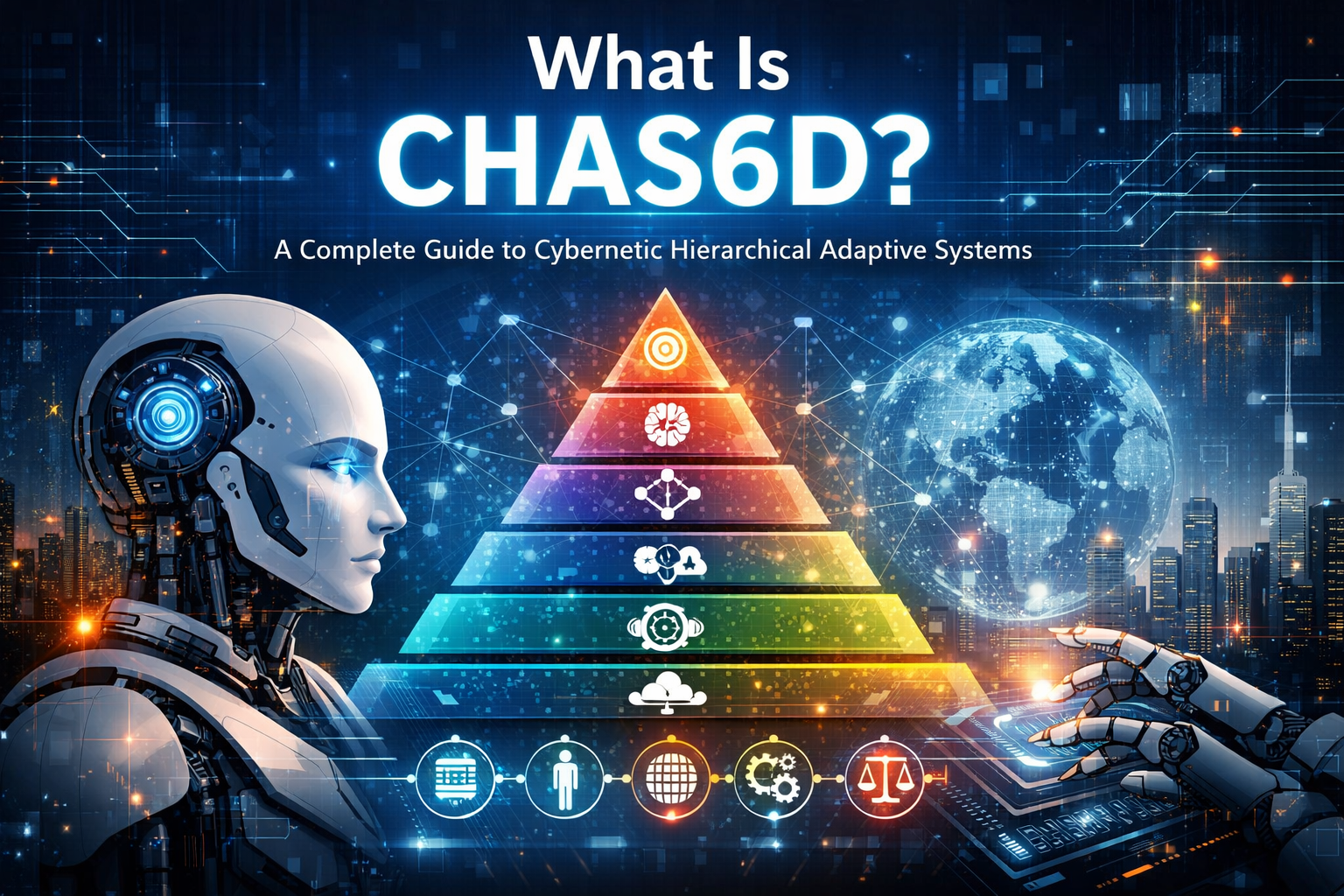
CHAS6D stands for ” Cybernetic Hierarchical Adaptive Systems in Six Dimensions “, which provides a complete theoretical and practical framework for understanding how advanced intelligent systems learn to self-control, develop their abilities, and make autonomous decisions in complex environments. We recognize CHAS6D as more than a technical abbreviation; it represents a structured vision for building next-generation artificial intelligence, robotics, and cyber-physical systems that closely resemble biological intelligence in adaptability and resilience.
The CHAS6D framework enables systems to operate in physical, digital, cognitive, and ethical domains through its continuous feedback mechanism and multi-layered control system, which drives self-improvement across various system components.
The Conceptual Foundation of CHAS6D
Fundamentally, Cybernetic Hierarchical Adaptive Systems in Six Dimensions mixes three strong concepts cybernetics, a hierarchical organization, and the adaptive intelligence principle – that are extended over six different dimensions. We see this mix as a must-have for making systems that can comfortably live through the unpredictable, data-heavy, and interconnected environments.
At the same time, the framework is inspired by neuroscience, systems engineering, artificial intelligence, and control theory, thus being an integrated architecture for intelligent self-evolving systems.
Breaking Down the Meaning of CHAS6D
Cybernetic Control and Feedback Intelligence
A cybernetic facet of CHAS6D is essentially about feedback-driven regulation. Cybernetics is the science that explores how systems keep track of their outputs, compare them to their objectives, and make adjustments to their internal operations accordingly.

In such CHAS6D-based models, feedback isn’t just something that happens after the fact—it’s the very core of intelligence. The systems are equipped with sensors to continuously monitor their surroundings, assess the results of their actions, identify any inconsistencies, and then, they self-correct instantaneously in a totally autonomous manner.
The cybernetic principles behind CHAS6D are rooted in feedback, control, and communication within intelligent systems. Cybernetics explains how systems observe outcomes, compare them against objectives, and adjust behavior accordingly, forming the backbone of adaptive intelligence. This foundational concept has been widely studied in cybernetics and intelligent systems, where feedback loops enable stability, learning, and self-regulation in both biological and artificial environments.
Hierarchical System Architecture
The hierarchical element brings in multi-tiered control frameworks, with each tier carrying out its distinctive role while also being in sync with the others. The lower levels are concerned with the implementation of the tasks, while the upper levels focus on strategic planning, decision-making, optimization, and even ethical consideration.
The structure of layers is somewhat like the human mind, allowing CHAS6D systems to handle complexities effectively, minimize overloading in decision-making, and stay viable even when certain parts malfunction.
Adaptive Intelligence and Learning
Adaptability in CHAS6D is not just about changing the rules. These systems are basically self-learning beings who keep improving their strategies, parameters and goals over time. They pick up on patterns in both internal and external data, and hence, CHAS6D systems grow in a proactive way rather than simply reacting.
Such adaptive intelligence is what gives machines the ability to forecast change, plan their actions in the best way, and constantly enhance their performance—these being the hallmark features of the next generation of autonomous systems.
Systems Thinking and Interconnectivity
CHAS6D sees intelligence as a whole system of interacting parts rather than one single algorithm. Each element engages with others through well-organized feedback loops, thus, the entire organism is capable of high-level reasoning, coordination, and problem-solving.
Going by this systemic method, the solution will be scalable, modular, and interoperable across different technical domains.
The Six Dimensions of CHAS6D Explained

1. Physical Dimension
The physical dimension defines the tangible interface between the system and its environment. It includes hardware components, sensors, actuators, energy constraints and spatial dynamics.
This dimension grounds intelligence in reality ensuring that decisions remain feasible and context-aware.
2. Data and Information Dimension
This dimension governs data collection, storage, processing and transmission. It ensures reliable information flow across hierarchical layers, enabling accurate perception and analysis.
Data integrity, latency management and contextual relevance are critical at this level.
3. Cognitive Dimension
The cognitive dimension encompasses reasoning, planning, abstraction and decision-making. It enables systems to evaluate multiple options, predict outcomes and choose optimal actions aligned with goals.
This dimension represents the “thinking” layer of CHAS6D intelligence.
4. Adaptive Dimension
The adaptive dimension manages learning, evolution and self-improvement. It monitors performance trends, identifies inefficiencies and updates internal models accordingly.
This dimension transforms static intelligence into continuous intelligence growth.
5. Network and Social Dimension
Modern intelligence rarely operates in isolation. The network/social dimension enables interaction with other systems, agents and networks.
It supports cooperation, competition, coordination and collective intelligence across distributed environments.
6. Ethical and Goal-Oriented Dimension
The sixth dimension ensures ethical alignment and goal coherence. It defines boundaries, values and priorities that guide system behavior.
This dimension is critical for trust, accountability and safe autonomy, especially in human-centered applications.
How CHAS6D Systems Operate
CHAS6D systems function through a continuous adaptive cycle:
- Environmental sensing and data intake
- Hierarchical processing and pattern recognition
- Strategic and operational decision-making
- Action execution and outcome monitoring
- Feedback integration and learning refinement
This cycle repeats indefinitely, enabling self-evolution and long-term intelligence growth.
Real-World Applications of CHAS6D
Artificial Intelligence and Machine Learning

The AI system gains enhanced transparency and robustness through its CHAS6D system which enables it to learn from multiple sources across different dimensions while improving its ability to generalize and interpret results.
Robotics and Autonomous Systems
The CHAS6D system enables robots to achieve safe operation in changing environments through its ability to establish human partnerships and use real-time system feedback for optimizing their activities.
Smart Cities and Infrastructure
The CHAS6D system enables intelligent traffic management and energy efficiency and urban development through its ability to connect multiple systems which use dynamic decision-making methods.
Healthcare and Medical Intelligence
Adaptive diagnostics, personalized treatment plans, and predictive health analytics benefit from CHAS6D’s multi-dimensional learning capabilities.
Cybersecurity and Threat Detection
CHAS6D-based security systems detect anomalies, anticipate attacks, and evolve defenses autonomously, outperforming static rule-based solutions.
Education and Personalized Learning
Adaptive learning platforms built on CHAS6D customize content delivery based on student behavior, progress, and learning styles.
Key Advantages of CHAS6D
- Continuous self-learning and improvement
- High resilience to uncertainty and disruption
- Scalable architecture across domains
- Efficient resource utilization
- Ethically aligned autonomous decision-making
CHAS6D and the Future of Artificial Intelligence

We consider CHAS6D to be the root architecture on which Artificial General Intelligence (AGI) could be built. As the CHAS6D Approach allows systems to change their learning strategies on the fly and to think across layers of reality, it breaks down the limitations of traditional AI models.
Essentially, the model transforms intelligence from being just a mechanism of static optimization to a self-aware, intrinsically motivated developer of new goals and means.
CHAS6D closely aligns with the evolution of modern adaptive artificial intelligence systems, where machines are designed to learn continuously rather than operate on static rules. By combining hierarchical decision layers with real-time learning, CHAS6D enhances AI systems’ ability to respond intelligently to change, uncertainty, and complex data streams. This approach reflects how leading technology organizations are advancing intelligent automation and self-improving AI models.
Challenges in Implementing
The implementation of CHAS6D faces multiple difficulties which include computational complexity, data integrity requirements, ethical governance challenges, system integration demands and security vulnerability issues. The solution to these problems requires a team effort which needs to connect technical skills with ethical standards and policy requirements for the domain.
The Future Outlook
With the evolution of technology, CHAS6D probably will revolutionize many fields such as self-driving cars, industrial automation, quantum systems, space exploration, etc.
By concentrating on versatility and ethical intelligence, it sets an example of eco-friendly technological advancement.
Conclusion
The Cybernetic Hierarchical Adaptive Systems in Six Dimensions (CHAS6D) framework represents a groundbreaking intelligent system design which operates through cybernetic feedback systems and hierarchical control systems and adaptive learning mechanisms and ethical alignment techniques to create machines that possess both automated functions and self-awareness and resilience and continuous development capabilities.
The CHAS6D framework establishes essential foundations which enable the development of intelligent systems that demonstrate both operational success and responsible behavior when they confront complex situations in actual environments.
Discover more expert articles and resources on the Techpass Blog